Sbalzi d’umore: da cosa possono dipendere e come gestirli
Indice di navigazione
Le espressioni “sbalzi di umore” o “oscillazioni umorali” descrivono il rapido e intenso alternarsi di stati d’animo contrastanti. Chi sperimenta sbalzi d’umore improvvisi li descrive come una specie di “altalena emotiva”: si può passare in modo repentino dalla tranquillità all’irritabilità, o dall’euforia a una sensazione di agitazione, talvolta senza una causa ben definita.
Le cause comuni dell’umore altalenante
È importante premettere che la vita emotiva non è mai lineare. In molti casi, l’origine di uno sbalzo d’umore può essere ricondotta a eventi stressanti (lavoro, famiglia, relazioni) o alterazioni del ritmo circadiano, che regola il ciclo sonno-veglia. Esistono però equilibri biologici specifici che possono influenzare la nostra stabilità:
- l’assetto endocrino e ormonale, soprattutto nelle donne, dove le variazioni tra estrogeni e progesterone (ciclo mestruale, gravidanza, menopausa) sono cause fisiologiche comuni di irritabilità1;
- le fasi dello sviluppo, specialmente durante la pubertà e l’adolescenza, quando le profonde alterazioni ormonali rendono le oscillazioni del tono dell’umore una parte ordinaria della crescita2;
- esiste anche una connessione inscindibile tra il funzionamento del sistema nervoso e la mente. Sostanze come la serotonina e la dopamina condizionano il nostro stato d’animo; la loro corretta sintesi dipende anche dalla disponibilità di specifici micronutrienti3.
Stile di vita e consigli pratici
Per supportare il benessere generale e l’equilibrio dell’umore, è possibile intervenire su alcuni aspetti dello stile di vita come:
- l’igiene del sonno: un riposo adeguato è importante per il benessere mentale. Mantenere orari regolari e un ambiente favorevole al sonno può contribuire al benessere mentale4;
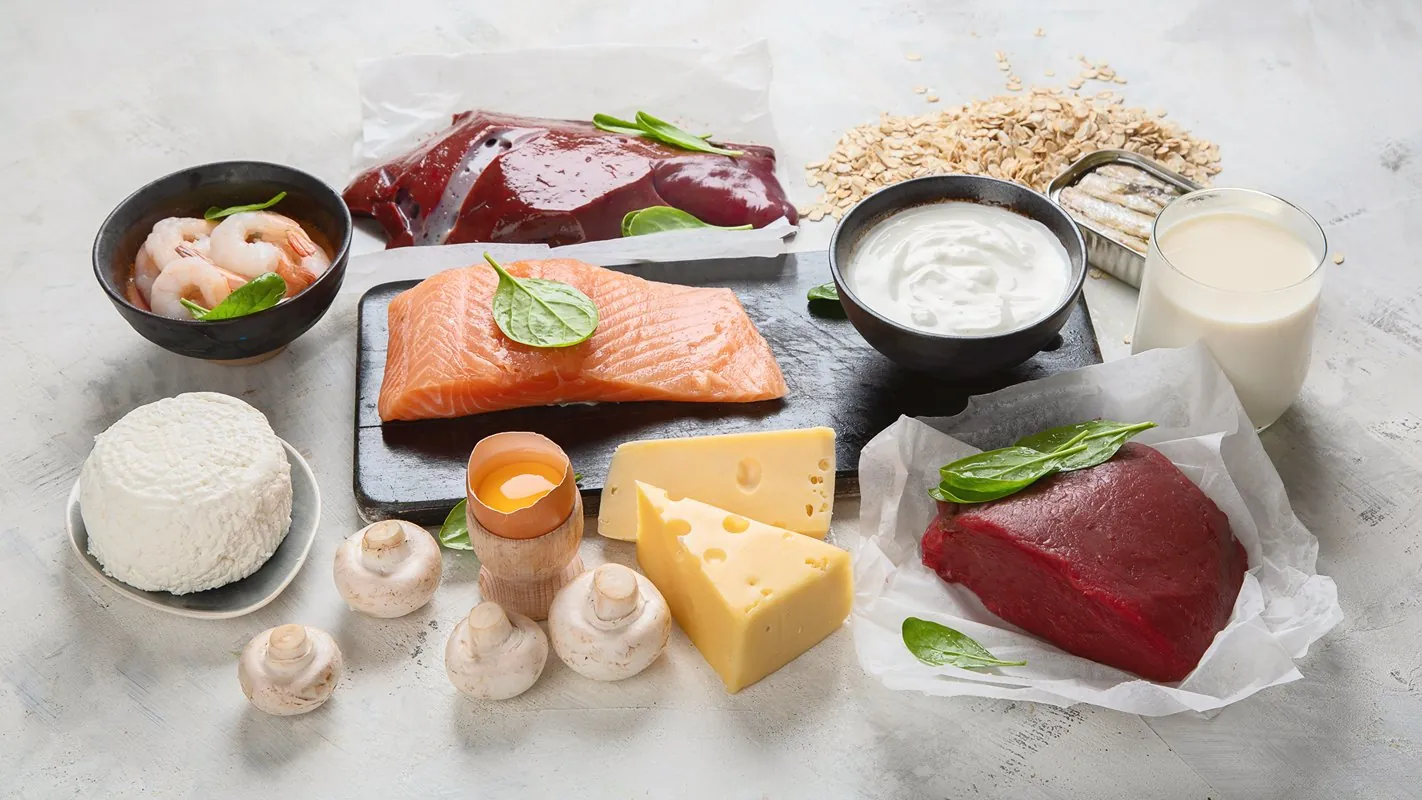
- l’alimentazione equilibrata: seguire un’alimentazione varia ed equilibrata può aiutare a mantenere livelli energetici più stabili. È preferibile limitare l’eccesso di zuccheri semplici e privilegiare carboidrati complessi (cereali integrali), proteine (pesce, carni bianche, legumi) e alimenti fermentati (yogurt, kefir)5;
- l’attività fisica: l’esercizio regolare stimola il rilascio di endorfine e favorisce il una sensazione di rilassamento gratificante6;
- la gestione dello stress: pratiche come la mindfulness, lo yoga o il training autogeno possono aiutare a favorire una migliore risposta allo stress e una sensazione di benessere7.
Il ruolo della Vitamina B12 nella funzione psicologica
All’interno di questo delicato equilibrio, anche la Vitamina B12 (cobalamina) svolge un ruolo, contribuendo alla normale funzione psicologica e al normale funzionamento del sistema nervoso.
In che modo contribuisce?
- Metabolismo: la Vitamina B12 partecipa come cofattore a diversi processi metabolici dell’organismo8;
- Energia: la Vitamina B12 contribuisce al normale metabolismo energetico e alla riduzione della stanchezza e dell’affaticamento, fattori che possono esasperare gli sbalzi umorali.
Assicurare livelli adeguati di Vitamina B12 non “migliora” l’umore, ma contribuisce al mantenimento delle normali funzioni dell’organismo, tra cui quelle psicologiche e del sistema nervoso9.
Integrare la Vitamina B12: la tecnologia IBSA
In alcuni momenti o in presenza di specifiche abitudini alimentari, l’apporto di vitamina B12 attraverso la dieta può risultare non adeguato; in questi casi può essere utile ricorrere a un’integrazione, sempre nel contesto di uno stile di vita sano e di un’alimentazione varia ed equilibrata.
La ricerca IBSA ha progettato un sistema per offrire un supporto tecnico e pratico. Grazie alla tecnologia IBSA FilmTec®, l’assunzione di Vitamina B12 in film orodispersibile (ODF) è estremamente semplice: il piccolo foglietto ultrasottile si scioglie sulla lingua in pochi secondi senza bisogno di acqua.
Disclaimer
I contenuti di questo articolo sono a scopo esclusivamente informativo e non sostituiscono il parere, la diagnosi o il consiglio del medico. Si raccomanda di fare sempre riferimento al proprio specialista.
Vitamina B12 IBSA è un integratore alimentare a base di Vitamina B12. Gli integratori alimentari non vanno intesi come sostituti di una dieta variata ed equilibrata e di uno stile di vita sano. Non superare la dose giornaliera consigliata. Tenere fuori dalla portata dei bambini al di sotto dei 3 anni.
1 Steiner M, Dunn E, Bonn L, Hormones and mood: from menarche to menopause and beyond, in “Journal of Affective Disorders”, Volume 74, Issue 1, pages 67-83, 2003 https://www.sciencedirect.com/science/article/abs/pii/S0165032702004329 The lifetime prevalence of mood disorders in women is approximately twice that of men. The underlying causality of this gender difference is not yet understood. There is increasing scientific attention to the modulation of the neuroendocrine system by fluctuating gonadal hormones. […] Premenstrual syndromes may be the result of an altered activity or sensitivity of certain neurotransmitter systems. Pregnancy and delivery produce dramatic changes in estrogen and progesterone levels as well as significant suppression along the HPA axis, possibly increasing vulnerability to depression. At menopause, estrogen levels decline while pituitary LH and FSH levels increase. The loss of modulating effects of estrogen and progesterone may underlie the development of perimenopausal mood disorders in vulnerable women.
2 Ibidem, The sudden appearance of higher levels of estrogen in puberty alters the sensitivity of the neurotransmitter systems. Moreover, the constant flux of estrogen and progesterone levels throughout the reproductive years portends constant modification of the neurotransmitter systems.
3 Fischer AG and Ullsperger M, An Update on the Role of Serotonin and its Interplay with Dopamine for Reward, in “Frontiers in Human Neuroscience”, Volume 11, page 484, 2017 https://www.frontiersin.org/journals/human-neuroscience/articles/10.3389/fnhum.2017.00484/full Among the brain’s neuromodulators, serotonin (5-hydroxytryptamine, 5-HT) is likely the most ambivalent one with regard to its supposed importance for behavior and level of understanding. […] On the other hand, influential theories of 5-HT functioning position it as a behavioral inhibitor essential in facilitating aversive processing, therefore, opposing the role ascribed to dopamine. These partly contradictory functions may be explained by interactions between different cell types within the raphe that depend on serotonin.
4 Walker, M. P, The Role of Sleep in Cognition and Emotion, in “Annals of the New York Academy of Sciences”, 2009 https://walkerlab.berkeley.edu/reprints/Walker_NYAS_2009.pdf Together with impairments of attention and alertness, sleep deprivation is commonly associated with increased subjective reports of irritability and affective volatility.
5 Roger A.H. Adan, Eline M. van der Beek, Jan K. Buitelaar, John F. Cryan, Johannes Hebebrand, Suzanne Higgs, Harriet Schellekens, Suzanne L. Dickson, Nutritional psychiatry: Towards improving mental health by what you eat in “European Neuropsychopharmacology”, Volume 29, Issue 12, pages 1321-1332, 2019 https://www.sciencedirect.com/science/article/pii/S0924977X19317237 Does it matter what we eat for our mental health? Accumulating data suggests that this may indeed be the case and that diet and nutrition are not only critical for human physiology and body composition, but also have significant effects on mood and mental wellbeing. While the determining factors of mental health are complex, increasing evidence indicates a strong association between a poor diet and the exacerbation of mood disorders, including anxiety and depression, as well as other neuropsychiatric conditions.
6 Peluso, M. A., & Guerra de Andrade, L. H., Physical activity and mental health: the association between exercise and mood, in “Clinics”, Volume 60 Issue 1, pages 61-70, 2005 https://www.researchgate.net/publication/7897884_Physical_activity_and_mental_health_the_association_between_exercise_and_mood Physical activity is an important public health tool used in the treatment and prevention of various physical diseases, as well as in the treatment of some psychiatric diseases such as depressive and anxiety disorders.
7 Pascoe, M. C., & Bauer, I. E., A systematic review of randomised control trials on the effects of yoga on stress measures and affect, in “Biological Psychology”, Volume 68, pages 270-82, 2015 https://pubmed.ncbi.nlm.nih.gov/26228429/ There is evidence that yoga has mood-enhancing properties possibly related to its inhibitory effects on physiological stress and inflammation, which are frequently associated with affective disorders.
8 Kennedy DO. B Vitamins and the Brain: Mechanisms, Dose and Efficacy—A Review, in “Nutrients”, Volume 8 Issue 2, page 68, 2016 https://doi.org/10.3390/nu8020068 Indeed, a deficiency in vitamin B12 results in a functional folate deficiency, as folate becomes trapped in the form of methyltetrahydrofolate. An actual or functional folate deficiency, with an attendant reduction in purine/pyrimidine synthesis and genomic and non-genomic methylation reactions in brain tissue, leads to decreased DNA stability and repair and gene expression/transcription, which could hamper neuronal differentiation and repair, promote hippocampal atrophy, demyelination and compromise the integrity of membrane phospholipids impairing the propagation of action potentials
9 Ibidem, The importance of all of the B vitamins to brain function is illustrated by the neurological and psychiatric symptoms commonly associated with deficiency in any one of these eight vitamins. For example, the primary symptoms of vitamin B6 deficiency are neurological, including depression, cognitive decline, dementia, and autonomic dysfunction and vitamin B12 deficiency is often manifested in the form of neurological symptoms prior to the appearance of more typical haematological changes . Notably, whilst about a third of those suffering folate or vitamin B12 deficiency present only with anaemia, a similar proportion present only with neuropsychiatric symptoms. Indeed, more than a third of psychiatric admissions have been found to be suffering deficiencies in folate or vitamin B12.